Guide
AI receptionist for contractors: what it actually does
Between a third and a half of calls to HVAC companies go unanswered. Not because anybody is slacking. Because you cannot answer a phone with your arm inside a furnace.
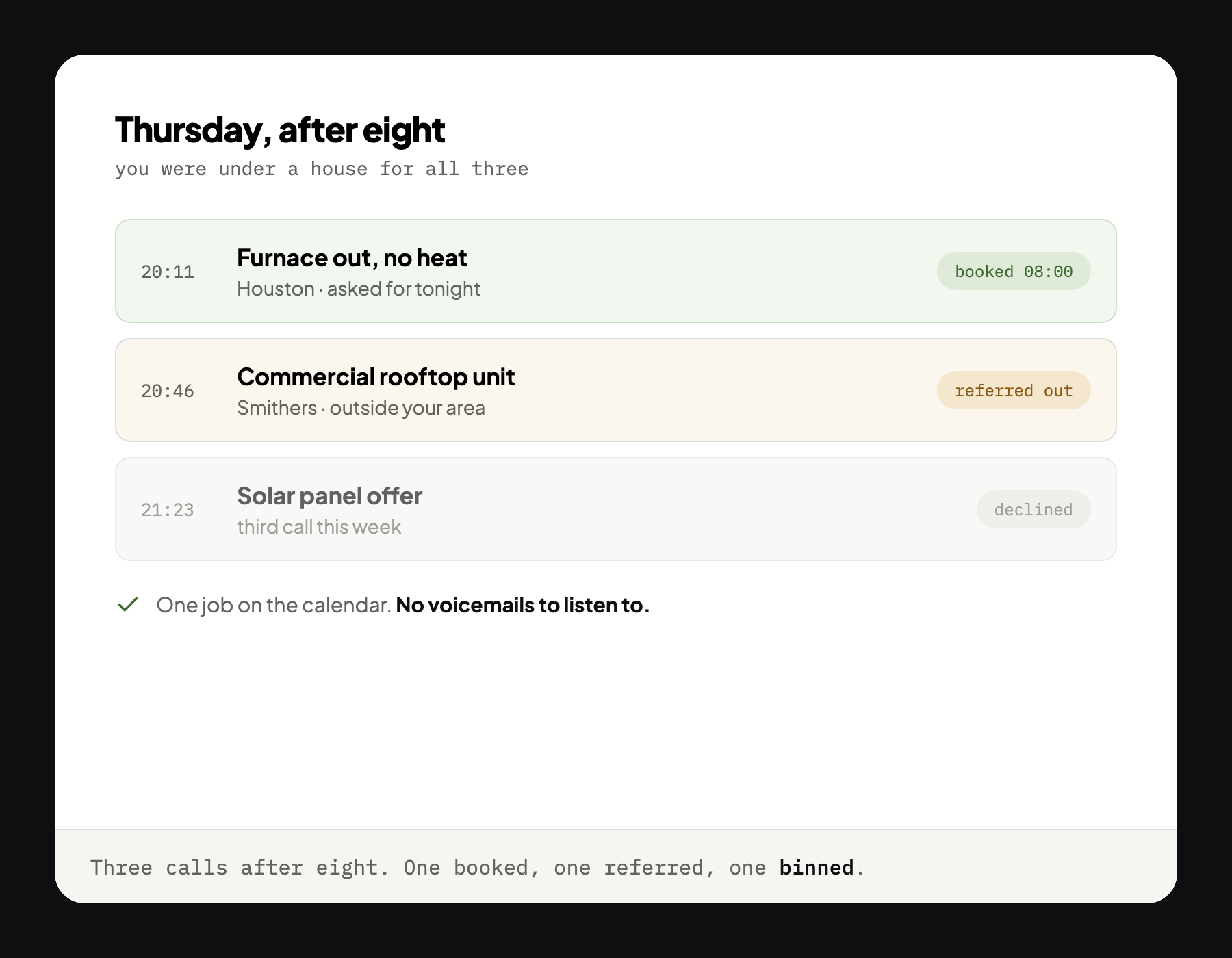
Short answer: an AI receptionist answers your phone when you cannot, asks the questions you would ask, and leaves the details on your phone. It suits solo operators and small crews with urgent work. It does not do the job, and it does not replace you on calls that need a person.
The problem it solves
Invoca's 2026 home services report, drawn from tens of millions of calls, found that between 35% and 50% of calls to HVAC companies go unanswered. Across home services trades, answer rates ranged from 32% to 74%.
Nobody is slacking. You cannot answer a phone with your arm inside a furnace, and you cannot take a call from a roof. The work and the phone want the same hands.
The part that stings is what happens next. Somebody with a dead furnace in January does not leave a voicemail and wait. They ring the next name on the page, and whoever picks up gets the job. The call was not lost because of price or reputation. It was lost because it rang out.
What it actually does on a call
You give it your rules once: where you work, which jobs you want, your minimum price, your hours, what you charge to come out. Then it answers.
- Picks up immediately, at eight in the evening, on a Sunday, on Boxing Day
- Asks what you would ask, in your order: what has happened, where they are, how urgent, how old the system is
- Books only times you have approved, so it cannot put you across town at four when you are already committed
- Turns down what you do not want: outside your area, under your minimum, or the fourteenth solar cold call this week
- Hands off to you the moment the call needs a person
Afterwards there is a written summary on your phone: who rang, what they need, where they are, when they can be there. Not a missed call notification. Not a voicemail you have to listen to standing in a loud shop.
The screening is the underrated half. Everyone sells the answering. The thing that changes your day is that the calls you do not want stop reaching you at all, and the ones outside your area can be referred to somebody who does want them, rather than binned.
What it doesn't do
Three things, said plainly, because the marketing in this category is not.
- It doesn't do the job. It gathers, screens and books. Every call that needs judgement still needs you
- It doesn't mean you never miss work. Anyone claiming that is overselling. Somebody who wants a human right now still wants a human right now. What it stops is the call dying at a voicemail
- It isn't a person. On a complicated, angry or grieving call, a human is better and it is not close
If it cannot hand a caller to you when they ask, it is not worth having. That is the one feature to check before you buy anything.
How it compares to the alternatives
Voicemail
Asks the caller to perform a monologue into silence, then asks you to listen to it in order, at a time when you can hear. Both halves are worse than a conversation. Most people simply hang up.
Missed call text-back
Cheaper, simpler, and genuinely useful. The call rings out and they get a text within seconds. The gap is that nothing was answered. Somebody with water coming through a ceiling wants to talk now, not type. Text-back narrows the gap; an answered call closes it.
An answering service
Real people, which wins on the messy calls. Against it: usually billed by the minute, so a busy week costs more precisely when you are most stretched, and the person answering is reading a generic script rather than knowing that you do not do commercial and do not cross the pass in winter.
Hiring somebody
The right answer eventually, and a real one for a shop with a crew. For a solo operator it is a wage, holiday cover, training and management, and they still go home at five, which is when a good share of the calls arrive.
What it should cost
Expect two numbers: a one-off setup fee to build it against your real calls and test it, then a monthly fee. Setup is where the value is. Anything sold with no setup is a generic script with your name typed into it.
There is a third number nobody puts on a pricing page: the phone minutes. Calls cost money to carry, whoever picks them up, and a single all-in figure either buries that cost in the monthly or has not accounted for it. Ask.
What matters is which part varies. Carrier minutes passed through at cost are fair. You used them, and a quiet month costs you less. A service fee that climbs per minute is a different thing: that bill rises exactly when the phone is busiest, which is the month you least want a surprise. Flat service fee, minutes at cost, is the shape to look for.
Whatever you are quoted, work out the number that actually matters: what one recovered job is worth to you. If a furnace swap is worth four figures, the question is not whether this is expensive. It is whether it recovers one job a year, and then whether you believe the person selling it.
When not to buy one
- You answer nearly every call, or somebody at home does. Then this solves a problem you do not have
- Your Google profile is unverified or your services section is blank. Fix the reason nobody is calling before optimising what happens when they do. This is most of the businesses we look at
- Your work is considered rather than urgent. A kitchen renovation is researched over weeks. That customer emails
- You will not read the summaries. Something that answers, promises a callback and then goes quiet is worse than the missed call
How to try one without committing
Ask for a demo built on your own business, not a vendor's recording. Then call it yourself and try to break it:
- Ask for a job outside your area. Does it decline cleanly?
- Ask for something you do not do. Does it know?
- Ask to speak to a human. Does it hand over immediately?
- Mumble, change your mind mid-sentence, give a wrong postcode
- Ask what it costs to come out. Does it say your number?
Anything that fails point three is not ready, whatever else it does well. And nothing should answer a real customer until you have heard it work.
See where you stand
We will tell you whether the phone is actually your bottleneck, or whether something further up the chain is costing you more. Free, before you pay us anything. If it is not the phone, we will say so.