Guide
There's an old phone number of yours online, and it's still ringing somewhere
Old business names, disconnected numbers, addresses from two moves ago. Nobody checks, because why would you.
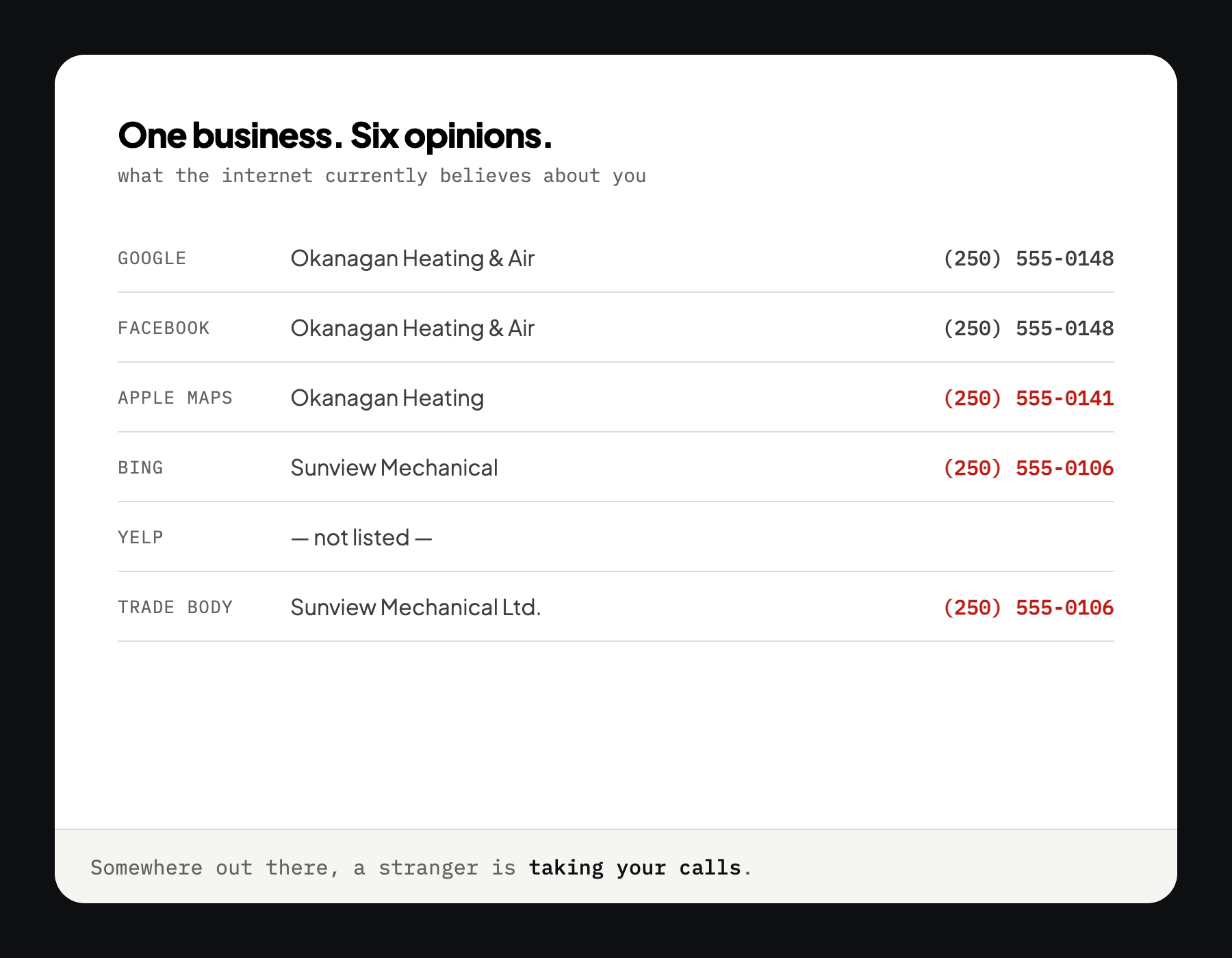
Short answer: Google cross-checks your name, address and phone number against other sites, and disagreement reduces confidence in your listing. Search each directory by phone number as well as by name. Old trading names are exactly what a name search misses.
Why Google cares
Google names prominence as one of three local ranking factors: how well known the business is. Part of working that out is checking whether the world agrees about who you are.
Your name, address and phone number appear in a lot of places you have forgotten about. When those disagree, say a number you gave up in 2019, a trading name you dropped or an address from two moves ago, Google has less confidence in any of it.
The customer-facing version is worse than the ranking version. A wrong number in a listing is a phone ringing in somebody else's house, or nowhere, while a person who wanted to hire you gives up and calls the next name down.
How to find them
Nobody checks this, which is why it is nearly always broken. It takes about an hour.
Check the six places a customer might realistically look:
- Google Business Profile
- Apple Maps
- Bing Places
- Yelp
- Your trade association or licensing body listing
For each one, and this is the part people skip:
Search by phone number and old business name, not just your current name. Businesses get listed under names they have since dropped. A name search finds nothing and you conclude you are not listed, when in fact you are, under a name you stopped using, with a number that no longer works.
Also try your address, and your own name. Sole traders end up listed personally more often than they expect.
Fixing them, in priority order
- Google. Everything else is a rounding error next to this one
- Facebook. Usually the second thing a customer checks, and frequently carries a number from whenever the page was set up
- Apple Maps. Every iPhone in your town uses it for directions, and almost no local business has ever claimed their listing
- Bing Places. Small share of searches, five minutes of work, and it feeds other services
- Yelp. Varies enormously by region and trade. Check whether anyone in your town actually uses it before spending an evening on it
- Trade and licensing listings. Often the most out of date and often the most trusted by the customer
Write down what you are claiming as you go: exact business name, exact address format, exact phone number. Then use those, character for character, everywhere. “Suite 4” and “#4” are not the same string to a machine even though they are obviously the same door.
What we found
We audited an HVAC company recently. Of 23 directories checked, 21 had nothing about them at all. The one that did had a company name they had dropped years earlier, and a phone number one digit off.
So the single place on the internet they existed, outside Google, was sending work to a stranger.
They had no idea. There is no notification for this, no dashboard, nothing that tells you. It sits there for years being quietly wrong.
When it's not worth the afternoon
Some honesty about scale, since this is the part of local marketing most often oversold:
- Fix the six above and stop. The returns fall off a cliff after that. Being on 47 directories nobody has heard of is not eleven times better than being on six
- If your Google profile is unverified or your services section is blank, do those first. This is a tidy-up job, not a rescue
- Paid citation services are worth considering only once the six that matter are correct and you still have gaps you cannot claim yourself
It is genuinely dull work. It is also the sort of dull work that quietly decides which of two similar businesses gets the call.
See where you stand
We will check where you are listed, where you are not, and which listings carry the wrong details. Free, before you pay us anything.