Guide
Which business directories actually matter
Six accurate listings beat sixty that disagree with each other, because disagreeing with yourself is the actual problem. Here is the short list and the test for everything not on it.
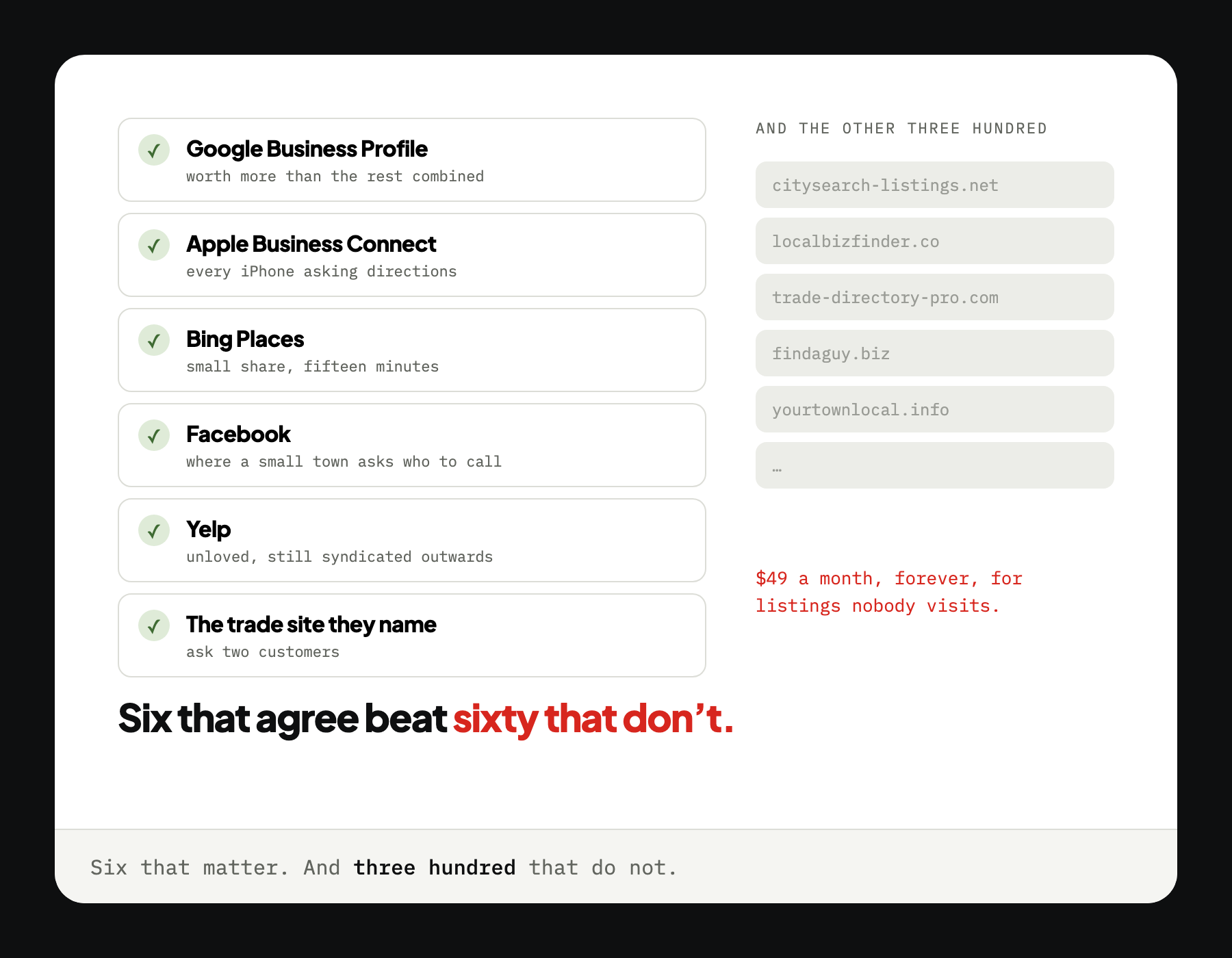
Short answer: Google Business Profile, Apple Business Connect, Bing Places, Facebook, Yelp, and whichever trade site people in your area genuinely use. Make all six match exactly, ignore the rest, and do not pay a citation service for three hundred listings nobody visits.
Why this matters at all
Google cross-checks what you say about yourself against what everybody else says about you. When your name, address and phone number agree in the places it looks, it is more confident the business is real and that it is where you say it is. When they disagree, it is less confident, and confidence is part of how it decides who to show.
That is the ranking argument, and it is real but modest. The bigger reason is duller: a wrong number on a directory is a phone ringing in a stranger's house while somebody who wanted you gives up. There is a whole guide on what happens when your details do not match. This one is about which places are worth your afternoon.
The ones that are worth doing
There are thousands of directories. Almost all of them are worthless to a contractor. These are the ones we would actually spend time on, in this order:
- Google Business Profile. Not really a directory, and worth more than everything else on this list combined. If you only do one thing, this is the thing
- Apple Business Connect. Every iPhone that asks for directions uses Apple Maps, not Google. It is free, it takes fifteen minutes, and most of your competitors have never heard of it
- Bing Places. Small share, tiny effort, and it feeds answers in places you would not expect, including some AI assistants
- Facebook. Whatever you think of it, in most small towns it is where people ask "who do I call for X" and get told. Your page needs to exist and have the right number on it, even if you never post
- Yelp. Unloved, and still syndicated into other places, so the details leak outwards whether you like it or not
- The one trade site people in your area actually use. HomeStars in much of Canada, Angi in much of the US, sometimes a regional board. Ask two customers where they looked before they rang you. Their answer beats any list
That last one is the test for everything else. If you cannot name a customer who used a directory to find somebody, it is not worth an afternoon, whatever its sales email says.
What to skip, and what to refuse to pay for
Do not buy a citation service. The pitch is 300 listings for a monthly fee. What you get is 300 listings nobody visits, most of them on sites that exist only to be sold to you, and a dependency: stop paying and many of them decay back to whatever they said before.
Do not chase volume. Six accurate listings beat sixty that disagree with each other, because disagreement is the actual problem. Every extra listing is another place your old number can be wrong.
Be careful with anything that wants to manage your Google profile through their own dashboard. Make sure you own the profile and can log into it directly. If you cannot, you do not own it.
Doing it properly, once
Write your details down first, exactly as you want them everywhere. This is the boring step that makes the rest work.
- The legal or trading name, with no keywords added. Not "Dave's Plumbing Kelowna Emergency 24 7"
- One phone number. The one that reaches you
- The address exactly as it appears on the Business Profile, unit format and all, or no address at all if you hide it
- One website URL, with or without the www, and the same choice every time
Then work down the list above and make every one of them match that card, character for character. Search each site by phone number as well as by name: old listings are usually under a trading name you dropped years ago and a name search will never find them.
When you find a listing you cannot claim or edit, note it and move on. One stubborn wrong entry on a site nobody visits is not worth a week.
How often to redo it
Once properly, then whenever something changes, and a fifteen minute check once a year. Details do not drift on their own, but you change a number, move a unit, or take on a trading name, and then there are two versions of you online.
Find out where you disagree with yourself
We will check your listing, your reviews, your directory details and your website setup, and tell you the two things worth fixing first. Free, before you pay us anything. If it comes back saying you are doing fine, we will tell you that too.