Guide
Google's AI is calling businesses for prices
A customer taps a button, and Google rings five businesses to ask what they charge. Here is what it asks, who it calls, and why your price stopped being a private conversation.
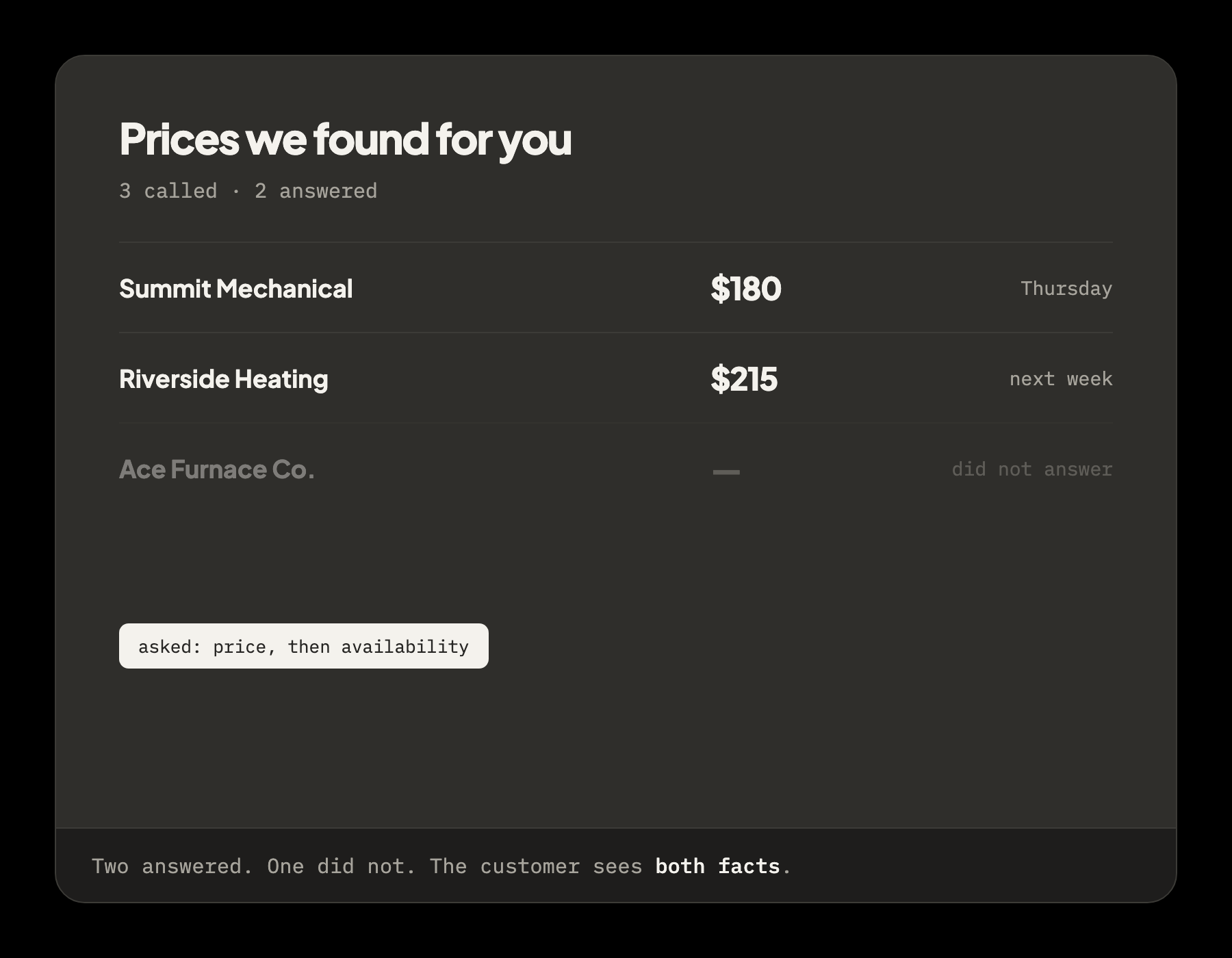
Short answer: Google’s AI phones local businesses on a customer’s behalf to ask price and availability, then emails them a summary. It is US-only for now. Where you rank decides whether it rings you, and what your phone says about price is shown to the customer next to your competitors.
What the feature actually is
There is a button in Google Search that reads Have AI check pricing. A customer taps it, answers a couple of questions about what they need and when, and Google’s AI telephones local businesses to ask what they charge and when they could do it. The customer gets an email summarising who said what.
Google calls the feature Ask for Me. Every call opens by announcing itself as an automated system calling from Google on behalf of a user, so it is not pretending to be a person.
Per Google’s own documentation it is available in English, to signed-in users over eighteen, in the US, on mobile and desktop. Google names auto repair, hair salons, pet groomers, wellness centres and driving schools as covered so far, and says it is working on expanding to more services. An expansion to home repair was announced in May 2026; at the time of writing it is not yet in the list Google publishes.
How it decides who to ring
This is the part worth understanding, because it happens before your phone is involved at all.
A Google spokesperson has told trade press that the AI works from ordinary local search rankings and contacts businesses that appear for the query, calling roughly the top five in the map pack. That detail is reported rather than documented — Google’s own help page does not say how it picks — so treat the number loosely.
The shape of it is not in doubt, though. There is a cutoff, and where you rank decides which side of it you are on. If you are eleventh for what somebody just searched, no amount of answering the phone helps, because the phone does not ring. If you have never checked where you actually stand, that is the place to start, and there is a guide on why a business does not appear in Maps.
What it asks you
Two things, in this order:
- What does it cost. For the specific job the customer described, not a general enquiry.
- When could you do it. Availability, in terms a customer can compare.
Both are questions a lot of businesses answer badly on the phone at the best of times, and this call will not arrive at the best of times. It arrives whenever the customer tapped the button.
What happens if nobody answers
Google’s help page says that where it cannot reach businesses, it emails the customer recommendations of other providers who might be able to help. Trade press has separately described unreachable businesses appearing under a businesses we couldn’t reach heading, listed below the ones that answered.
Those are not quite the same outcome and we are not going to pretend to know which one a given customer sees. The part that matters is the same in both: not answering does not make you neutral. It makes you the one who did not answer, next to two who did.
Your price stopped being private
This is the change most people miss, and it is bigger than the missed call.
When a person rings and asks what something costs, the answer stays between you and them. When Google’s AI asks, the answer is written down and emailed to the customer beside what two competitors said. The number your phone gives out on a Sunday evening is no longer a quote. It is a listing.
Which means it is worth knowing what your phone currently says. Not what you think it says — what it actually says, when you are not there. If somebody answers for you, whether that is a person, a service or an AI receptionist, the number they give is now public-facing.
What to do about it
- Find out where you rank for the two or three things people actually search. That decides whether you are in the calling list at all.
- Decide your price answer before you are asked. A range with a condition attached beats "it depends", and it beats a number you regret.
- Decide your availability answer too. "This week" is an answer. "I would have to check" is not, to a machine that is comparing you.
- Make sure something answers. Voicemail is not a participant in this. A text-back does not help either — the caller is not reading texts.
- Check your profile and website say the same thing, because those are what Google falls back on when it is building the picture.
None of this is urgent in the sense that it will cost you a customer tomorrow. It is urgent in the sense that the thing deciding whether you get called is already being decided, every day, by where you rank and what your phone does at seven in the evening.